
Understanding the Importance of Reinforced Concrete Borders and Natural Stone Curb Edges in Northern Minnesota

Northern Minnesota’s climate presents unique challenges for outdoor hardscape installations. Freeze-thaw cycles, heavy snowfall, and shifting soils can quickly degrade standard edging materials, leading to costly repairs and compromised aesthetics. At Legacy Hardscapes, we approach every project with a strong engineering mindset, focusing on long-term performance and durability. One key element in our installations is the use of reinforced concrete borders combined with natural stone curb edges. These features protect patios, walkways, and retaining walls from the harsh Minnesota environment while maintaining a clean, natural look.
In this post, I’ll explain why standard plastic or aluminum edging often fails here, how reinforced concrete borders lock pavers in place, and why large natural stone pieces buried partially below grade make excellent curb restraints. I’ll also share how these methods safeguard your investment for decades, with examples from our work in Duluth, Hermantown, Cloquet, Two Harbors, Silver Bay, Ely, Lake Vermilion, and Grand Marais.
Why Standard Plastic and Aluminum Edging Fails in Freeze-Thaw Climates
Many homeowners and contractors opt for plastic or aluminum edging because it’s inexpensive and easy to install. Unfortunately, these materials do not hold up well in Northern Minnesota’s freeze-thaw conditions.
Plastic edging becomes brittle and cracks after repeated freezing and thawing. It can warp or break under pressure from soil movement or snowplows.
Aluminum edging bends and shifts when exposed to frost heaving. It lacks the rigidity to resist lateral forces from expanding soils.
Both materials fail to provide a solid edge restraint, allowing pavers or stones to move, settle unevenly, or separate over time.
These failures lead to uneven patios, loose pavers, and the need for frequent repairs. In a climate where the ground freezes deeply and thaws repeatedly, relying on flexible or lightweight edging is a short-term solution at best.
How Reinforced Concrete Borders Lock Pavers in Place
Reinforced concrete borders offer a strong, permanent edge restraint that withstands freeze-thaw cycles and soil movement. Here’s how they work:
Concrete is poured with steel reinforcement bars (rebar) to increase tensile strength and prevent cracking.
The border is formed along the patio or walkway perimeter, creating a solid frame that holds pavers tightly.
This frame prevents lateral shifting of pavers caused by frost heaving or heavy foot traffic.
Concrete borders can be custom-shaped to fit curves or straight lines, ensuring a precise fit.
The rigidity of concrete means it absorbs and distributes pressure evenly, reducing stress on individual pavers.
By locking pavers in place, reinforced concrete borders maintain a level, uniform surface that lasts for decades. This method is especially important in Northern Minnesota, where freeze-thaw cycles can cause significant ground movement.
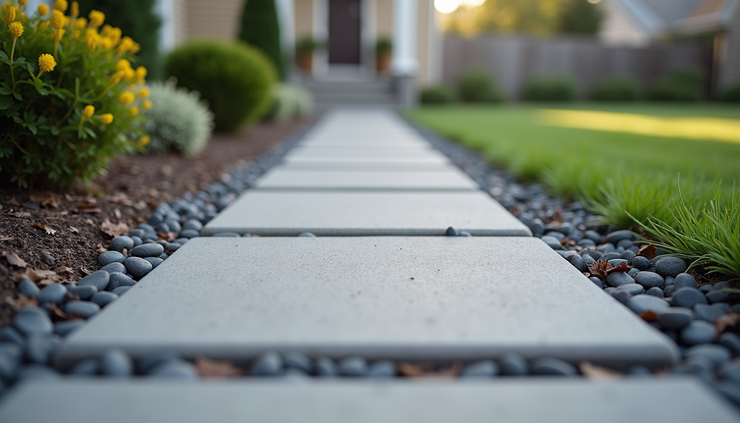
Reinforced concrete borders provide a strong frame that keeps patio pavers stable through freeze-thaw cycles.
Using Large Natural Stone Pieces as Buried Curb Restraints
Natural stone curb edges add both beauty and strength to hardscape projects. When large stones are set partially below grade, they serve as effective curb restraints that complement concrete borders.
Large stones resist lateral movement better than smaller stones or manufactured edging.
Burying stones partially below ground creates a hidden anchor that holds the curb firmly in place.
This technique maintains a clean, natural aesthetic without visible concrete or metal edging.
Natural stone is highly durable and weathers gracefully over time.
Stones can be sourced locally from areas like Ely, Lake Vermilion, or Grand Marais, adding regional character.
By combining natural stone curbs with reinforced concrete borders, we create a hybrid system that balances structural integrity with visual appeal. This approach suits patios, walkways, and retaining walls in Duluth, Hermantown, Cloquet, and beyond.
How Setting Larger Stones Partially Below Grade Maintains Clean Aesthetics and Increases Durability
The key to using natural stone curb edges effectively lies in how they are installed:
Stones are set into a compacted base below the surface, anchoring them against frost heave.
The visible portion of the stone is carefully aligned and leveled to create a smooth edge line.
This method hides the bulk of the stone underground, preventing it from looking bulky or out of place.
It also protects the stone from direct impact by snow removal equipment or foot traffic.
The result is a durable, low-maintenance curb that blends seamlessly with the surrounding landscape.
This installation technique reflects our commitment at Legacy Hardscapes to combining engineering principles with natural materials for long-lasting results.

Large natural stone curb edges set partially below grade provide strong, durable restraint while maintaining a clean look.
Why Proper Edge Restraint Protects Your Long-Term Investment
Investing in a patio, walkway, or retaining wall is a significant decision. Proper edge restraint is critical to protecting that investment:
It prevents shifting and settling that cause uneven surfaces and trip hazards.
It reduces maintenance costs by minimizing repairs and replacements.
It preserves the design integrity of your hardscape, keeping it looking new longer.
It increases property value by ensuring your outdoor spaces remain functional and attractive.
It supports the structural stability of retaining walls, preventing soil erosion and collapse.
Our experience as a hardscape contractor in Duluth and Northern Minnesota shows that projects with reinforced concrete borders and natural stone curbs outperform those with standard edging by a wide margin. This is especially true in areas like Two Harbors, Silver Bay, and Lake Vermilion, where freeze-thaw cycles are intense.
Engineering Mindset and Commitment to Long-Term Performance
At Legacy Hardscapes, we approach every project with an engineering mindset. We understand the forces at work beneath the surface and design solutions that stand up to them. Our use of reinforced concrete borders and natural stone curb edges is part of this philosophy.
We analyze soil conditions and climate factors before installation.
We use materials and techniques proven to resist frost heave and erosion.
We combine structural strength with natural aesthetics.
We tailor solutions to each client’s site and preferences.
We back our work with decades of experience serving Duluth, Hermantown, Cloquet, Ely, Grand Marais, and surrounding areas.
This approach ensures that your patio or retaining wall will not only look great but also perform reliably for years to come.
Service Areas We Proudly Serve
We bring our expertise in reinforced concrete borders and natural stone curb edges to a wide range of communities across Northern Minnesota, including:
Duluth
Hermantown
Cloquet
Two Harbors
Silver Bay
Ely
Lake Vermilion
Grand Marais
No matter where your property is located in this region, we understand the local climate challenges and design hardscapes that last.
Final Thoughts on Durable Hardscape Edging in Northern Minnesota
Choosing the right edge restraint is essential for any hardscape project in Northern Minnesota. Standard plastic or aluminum edging cannot withstand the freeze-thaw cycles and soil movement common here. Reinforced concrete borders lock pavers firmly in place, while large natural stone curb edges buried partially below grade provide strong, attractive curb restraint.
Together, these methods protect your investment, reduce maintenance, and maintain clean aesthetics. At Legacy Hardscapes, we combine engineering knowledge with quality materials to deliver installations that last decades. If you want a patio or retaining wall built to stand up to Northern Minnesota’s toughest conditions, contact us today to learn how we can help.


Comments